Wednesday, December 25, 2013

Shrine of Our Lady of Guadalupe - Santa Fe, New Mexico

~

The Shrine of Our Lady of Guadalupe in Santa Fe, established in 1777, is the oldest still standing shrine built in honor of our Lady of Guadalupe in the United States. It is an enduring landmark, commemorating the apparitions of Mary to the Aztec peasant Juan Diego at Tepeyac, Mexico between December 9 and 12 in 1531. As recorded then by the court of  Bishop Fray Juan de' Zumiarraga of Mexico City, Juan Diego reported to the Bishop that he had seen a young girl, whom he presumed to be the Virgin Mary, while walking on the hill of Tepeyac, outside Mexico City and she had asked him to petition the Bishop for the construction of a church for worship of the Lord Jesus Christ. The Bishop sent Juan Diego away, asking him for proof of this apparition of the Virgin Mary. The following day, Juan Diego returned to the Bishop and said, " She sent me to the top of the little hill of Tepeyac where I had seen her before, to cut some rose flowers there ... and she told me that I should give them to you from her and in that way I would prove it.  Here they are, please receive them." Juan Diego then opened his tilma (peasant cloak) and the roses spilled out. revealing a perfect, miraculous image of the Virgin on the fabric. After viewing this image, Bishop Zumiarraga approved the construction of The Church of The Virgin of Guadalupe at Tepeyac. It is reported that wihin 30 years, almost the entire Aztec nation converted to Christianity. The church at Tepeyac has been replaced by the Cathedral Basilica of Our Lady of Guadalupe, the most visited Marian shrine in the world. The original Juan Diego tilma image of Our Lady of  Guadalupe is on display in the Basilica today and has decayed little over the past 483 years, defying scientific explanations. Miraculous healings of Christian pilgrims visiting the Cathedral Basilica have been reported.
Santuario de Guadalupe    The Shrine of Our Lady of Guadalupe in Santa Fe has its own unique features.  The Shrine consists of the historical chapel - the Sanctuario de Guadalupe, a new larger Church of Our Lady of Guadalupe to accommodate the burgeoning parish, the El Cerro de Tepeyac - a walking path featuring six tile mosaics by the artist Arlene Cisneros Sena, illustrating the apparitions of Our Lady of Guadalupe to Juan Diego and the newest addition, a 12 foot statue of our Lady of Guadalupe which stands in front of the Sanctuario de Guadalupe, greeting visitors. There is also a prayer station at the statue of Saint Bernadette. A rose garden with flowers from the Holy Lands in the Middle East embellishes the entrance to the Sanctuario.
The original Church of Our Lady of Guadalupe, a small adobe structure, was built in 1777 on the banks of the Santa Fe River near the end of the Camino Real. The church was constructed on a Latin cross floor plan, with thick 3 foot adobe walls, a flat roof supported by pine vigas, a dirt packed floor and a 3 tiered bell tower,  Owing to disrepair the Church was closed in 1826 by Vicar Fernandez San Vicente of the Diocese of Durango, Mexico and  remained closed until 1881 when Bishop Lamy of the Archdiocese of Santa Fe appointed Father De Fauri from Denver as pastor with the charge of raising the funds to reopen Our Lady of Guadalupe Church. Father De Fauri was able to make much needed repairs. A new cupola was added to replace the partially collapsed roof. A 575 pound bell was installed in an orange colored spire which replaced the old bell tower and mock Gothic windows were placed in the walls.  The parish flourished until 1922 when a fire razed the church's roof , collapsed the spire and damaged the painted frescoes, The walls and altar survived. Restoration this time was made in the style of a California Mission with a new pitched roof , a bell tower and a wooden floor. Owing to further deterioration of the adobe walls, the church was closed in 1961 and the new and larger Our Lady of Guadalupe Church was opened. In 1973 the Sanctuario was leased to the Guadalupe Historical Society, which converted it into a museum and eventually raised the revenue to restore the adobe walls and interior.  In 2006 the Archdiocese of Santa Fe transferred the Sanctuario back to the Our Lady of Guadalupe parish. Daily morning masses, Saturday evening mass and marriages are now performed in the Sanctuario.

The outstanding artistic feature of the Sanctuario is the reredos (altar screen) with a replica of Our lady of Guadalupe painted in 1783 by Jose de Alzibar  in Mexico City and carted in sections by ox train up the Camino Real to Santa Fe where it was stitched back together. The reredos also contains images of Our Lady of Guadalupe's apparitions to Juan Diego. The 12 foot statue of Our Lady of Guadalupe which stands in front of the Sanctuario was  sculpted by the Mexican artist Georgina Farias and was trucked from Mexico to Santa Fe in 2008. The statue is surrounded by offerings of roses on a platform of memorial bricks stenciled with the names of parishioners. Like the Sanctuario it is a site of devotional prayers, requesting the intercession of Our Lady of Guadalupe.
When Archbishop Michael Sheehan dedicated the Statue of Our Lady of Guadalupe on December 12, 2008 he stated that " If the Cathedral Basilica of Saint Francis is the heart of Santa Fe then the Shrine of Our Lady of Guadalupe is the soul of Santa Fe". This would seem evident from the numerous and varied images of Our Lady of Guadalupe in the capitol city of New Mexico. She has been painted on storefronts, garage doors, automobiles - almost everywhere you walk in Santa Fe you will see er image. The Shrine of Our Lady of Guadalupe is the center-piece of this devotion. It is a place that beckons pilgrims. Here Mary is always waiting for our prayers, wanting to provide the same maternal affection and care to all of mankind that she bestowed on Her Son, our Lord, Jesus Christ.

To view photos and a video of the dedication of the Statue of Our Lady of Guadalupe click on

Our Lady of Guadalupe: A journey

guadalupejourney.blogspot.com/


Tuesday, October 29, 2013

Shrine of Saint Therese of Lisieux in Albuquerque


On a recent Sunday I attended Mass at Saint Therese in Albuquerque where I visited the Shrine of  Saint Therese of Lisieux. I knew little about this Saint but was struck by the devotion of the women who came after Mass to kneel and pray before the life size wax figure of Saint Therese, lying at rest. The shrine itself was relatively modest, befitting what I later learned was Therese's spiritual pathway. The shrine room in the Church's vestibule was small, decorated with photos tracing her life from childhood to her entry into the Carmelite convent at age 16 and to the time of her death from Tb at age 24, when she still appeared younger than her years. There was a photo of her home in France, of the Carmelite convent and its chapel in Lisieux , of her religious art work, and a copy of her treatise on prayer. Her childhood photos all exhibited a wistful smile, what I perceived as genuine happiness. Although she suffered much from illness as a Carmelite nun, the photos from her convent years reveal no anxiety or depression, just a peaceful and  prayerful countenance. The Shrine room also contained a holy water dispenser for visitors, of special significance as Saint Therese, when ill, often sprinkled her bed in the convent's infirmary with holy water, to quell the temptations of the devil.
My visit to Saint Therese's Shrine stoked my curiosity about this Saint and so led me to read her spiritual autobiography, "The Story of a Soul", which she wrote during the later years of her life.  Her writing, in the form of correspondence to her Mother Superior, reveals a quest for sainthood beginning in childhood, " You know that I always wanted to be a saint; but compared with real saints I know perfectly well that I am no more like them than a grain of sand trodden beneath the feet of passers-by is like a mountain with its summit lost in the clouds." She then came to the understanding, " God would never inspire me with desires which cannot be realized, so in spite of my littleness I can hope to be a saint." In reading the scriptures, she was struck by the words of Jesus, " Whoever is a little one, let him come to Me." Her search for the pathway to sainthood then led her to these words of the prophet Isaiah,  "You shall be carried at the breasts and upon the knees: as one whom the mother caresseth, so I will comfort you." She realized that as a child raises his arms up to his parents happy to be lifted up, so too must we live in our trust of a loving Lord. To her, this meant that we are all children vis a vis God. It meant that there was another path to Heaven which she could follow - what she called the little way. She later writes," I know it, love alone can make us pleasing to God, so I desire no other treasure. Jesus has chosen to show me the only way which leads to the Divine Furnace of love; it is the way of childlike self-surrender, the way a child sleeps, afraid of nothing, in its father's arms."                                                                                                                                                                   In her quest to draw upon the love of God, Therese thought of herself as one of God's little flowers in a garden, resplendent with roses. She writes," So it is in the world of souls, the living garden of the Lord. It pleases Him to create great saints, who may be compared with the rose: but he has also created little ones, who must be content to be daisies or violets nestling at His feet to delight His eyes when he should choose to look at them. The happier they are to be as He wills, the more perfect they are." She further elaborates this spiritual insight,  " Our Lord's love shines out just as much through a little soul who yields completely to His Grace as it does through the greatest". At the end of her memoir and close to the end of her human life she describes the little way she can  love Christ, " So my Beloved, shall my life be spent in Your sight. I can prove my love only by scattering flowers, that is to say, by never letting slip a single little sacrifice, a single glance, a single word; by making profit of the very smallest actions, by doing them all for love."
I  encourage Christian pilgrims to visit the shrine of Saint Therese in Albuquerque, to pray that like Therese, we too can draw upon the love of Christ to find the "little way" to return this love and to place our full trust in Him.

For directions to Saint Therese Church and Shrine in Albuquerque, click on

St Therese of the Infant Jesue Catholic Church Parish

www.littleflowerabq.org


Monday, September 30, 2013

La Conquistadora


                                                                                                                                                                                                                                                                                                                                                                                                                                                                 My name is La Conquistadora. I have had this name for 388 years, ever since I came to the Southwest with the Spanish pioneers who called themselves conquistadors. I am a small wooden statue of the Blessed Virgin Mary, dressed in real clothes with an extensive wardrobe like a Spanish Queen of old. Every single year I have been in Santa Fe, I have been taken out in procession, and not a day has passed without someone beseeching the Mother of God for intercession in my presence. I currently reside in the Our Lady Chapel in the Cathedral Basilica of Saint Francis Assisi. I haven't always had such splendid surroundings. I was enclosed in a crate measuring 40 inches long by 24 inches wide and 22 inches deep and carted by an ox train from Mexico City to Santa Fe in 1625. Upon arriving in Santa Fe I was placed in my new home, the parish Church of Our Lady of the Assumption, which had mud floors and a leaking roof. In 1640 my church, called a shanty by the Franciscans, was razed and I was enthroned on the altar in the new and larger adobe church also entitled Our Lady of the Assumption. For a time there was peace and tranquility and a spirit of religious devotion took hold of the Spanish settlers. I also received visits from the nearby Pueblo Indians and the more distant Apaches who were very curious about me. The entire population of Santa Fe celebrated my presence on the feast of the Immaculate Conception when I was dressed in silk and gold braid and was taken out in procession as Our Lady's representation. In honor of her new feast day, both I and the parish Church became known as Our Lady of the Immaculate Conception. In the ensuing years as  hostilities broke out between the Spanish settlers and surrounding Pueblo tribes, the Spanish visited me more often, usually to say the rosary, requesting the intercession of the Blessed Virgin Mary for the safety of their families. Hence I became known as Our Lady of the Rosary.  Prayers alone didn't suffice to quell the coming Pueblo uprising as mistrust had developed between the neighboring tribes and the Spanish, in large measure owing to Spanish politicians who continually exploited the tribes. On August 10, 1680 the Pueblo tribes and Apaches joined forces to attack the Spanish settlers across the territory. Many Friars and settlers perished. On August 15 Santa Fe was attacked and both San Miguel Mission and Our Lady of  Assumption Church were set afire. I was rescued by devotees and was taken to the fortress-like Palace of the Governors where the Spanish resisted the Pueblo onslaught for a full five days. Finally on August 21, the remaining Spanish settlers, friars and conquistadors decided to leave Santa Fe and travel south all the way back to Our Lady of Guadalupe Mission at El Paso del Norte. In 1684 the Spanish exiles from Santa Fe built a chapel - Our Lady of Conquest at San Lorenzo, a few miles down the Rio Grande river from El Paso and this became my home until 1692 when my new knight, Don Diego de Vargas, was sent from Madrid to lead the exiled Spanish back into the New Mexico territory. Don Diego de Vargas had an intense devotion to our Blessed Mother and he prayed before me daily for her intercession.. He was especially inured to my image likeness of Blessed Mary and appreciated the deep connection between myself and the original Spanish settlers of New Mexico. After gathering his forces and the exiled Spanish settlers at San Lorenzo and El Paso, Don Diego de Vargas brought me by wagon train back to Santa Fe in the summer of 1692. Before entering Santa Fe, Don Diego and his conquistadors offered prayers in my presence to the Blessed Virgin Mary for their safety and success. Surprisingly the Pueblo tribes offered little resistance, convinced by Don Diego de Vargas that they should welcome the image of our Blessed Mother, also their spiritual Mother, back to their lands. Indeed there was a large celebration of Spanish and Indians together when we arrived at the plaza in Santa Fe and the Friars erected a large white cross. I was placed in a small chapel in the Palace of the Governors and received almost daily visits from then Governor Don Diego de Vargas until his untimely death in 1704. Ten years later a large parish church was built on the east side of the plaza and was dedicated to St. Francis. Connecting with the north transept of this church, a chapel with intricately carved beams and corbels was built for me. Here at last I had my permanent throne where I sit today, although in 1850 a much larger cathedral church was built over and around the old Saint Francis church which was then disassembled with my chapel left intact and renamed the Our Lady Chapel, currently the most historic venue of the Cathedral. I sit here daily unless I am taken out in procession on Blessed Mary's feast days or when I'm escorted to the Rosario Chapel for viewing in celebration of Don Diego de Vargas's peaceful reentry into Santa Fe in 1692. I always await the prayers of the faithful and especially listen to those who truly believe in the Blessed Virgin Mary's assumption into heaven. I also fervently wish to help those who are desperate for God's mercy. I welcome all pilgrims to come and pray for the Blessed Mother's intercession with our Lord Jesus Christ on behalf of their intentions.
                                                                                                                                                              Click below for a video of La Conquistadora in procession.

La Conquistadora - YouTube

www.youtube.com/watch?v=zXX-deNx4Rg
Jun 24, 2009 - Uploaded by jedareynolds
 

Sunday, September 29, 2013

Saint Francis Cathedral - Santa Fe


The Cathedral Basilica of Saint Francis of Assisi, located one block east of the Plaza, is the eminent architectural and historical landmark of Santa Fe. The Cathedral was the dream of Archbishop Jean Baptiste Lamy, the first Vicar of the Archdiocese of Santa Fe, who arrived in Santa Fe in 1850 to discover that a small adobe mission church, La Parroquia, with a leaking roof and mud floors, was the mother church for the new archdiocese. Archbishop Lamy did all he could to raise funds for a Cathedral. He sold his horse carriage and furnishings from the Bishop's residence, convinced local merchants to contribute, obtained pledges from the Bishops of Cincinnati and St. Louis, established a tithe system for Catholics in the Archdiocese of Santa Fe and returned to his native Southern France to collect donations. The cornerstone was laid in 1860 and the new cathedral was constructed around La Parroquia, so that Santa Fe residents would continue to have a church for worship. Work on the Cathedral slowly progressed in starts and fits as funding waxed and waned. Bishop Lamy oversaw most of the Cathedral construction but died in 1888 before completion and consecration of the Cathedral in 1895. Clearly the Cathedral bears his signature. It was designed in the Romanesque revival style popular in Lamy's Southern France. As such the cathedral features characteristic round arches separated by Corinthian columns and truncated square towers. The Cathedral was built from yellow limestone blocks quarried near the present site of Lamy, New Mexico. A keystone brick arch was constructed above the main entrance and contains a carved triangle with the Tetragrammaton in Hebrew. It was reported that Bishop Lamy recommended this carving in appreciation of financial contributions made by local Jewish merchants towards the building of the Cathedral. During the restoration in 1986, new bronze doors were created, each with ten large panels that portray intertwining civic and religious events in the history of the Catholic Church in Santa Fe. A 2005 addition to the upper facade of the cathedral is a small, round window featuring a dove, the symbol of the Holy Spirit. The outside portico features statues of Saint Francis, the patron saint of the Archdiocese, Kateri Tekakwitha, the first Native American to be canonized, and of course Bishop Jean Baptiste Lamy, whose remains are buried in the crypt beneath the Cathedral floor.
Entering the Cathedral's nave, one's attention is immediately drawn to the floor to ceiling altar screen in the main sanctuary. This reredos, the work of the renowned iconographer, the Franciscan Brother Robert Bly, titled Saints of Americas, depicts 13 saints of North and South America, as well as Our Lady of Guadalupe. In the middle of the reredos is a nicho with a blue robed statue of Saint Francis of Assisi, which was carved in Mexico City in 1710. Also on display in the sanctuary are two large oil paintings that once graced La Parroquia. The Agony in the Garden and The Arrest of Jesus, proclaim our Lord's sacrifice. These are works of the renowned Mexican artist, Pascual Perez, which also date to 1710 and were brought to Santa Fe from Mexico City by ox-cart. Above the altar is the six foot San Damiano Cross, a replica of the crucifix in the Basilica in Assisi, where Saint Francis prayed and was inspired to restore the Church by serving the sick and the poor. Adorning the side walls of the Cathedral's nave are retablos (two dimensional paintings on wood) of the Stations of the Cross by the contemporary New Mexico artist, Maria Romero Cash. In Penitente style, the Stations are edged with painted red curtains that add drama to Christ's passion. In between the Stations are Bishop Lamy's French imported, stained glass windows illuminating the lives of the Apostles. The American made celestory windows overhead depict the coat of arms of the Archbishops of Santa Fe.
Passing through a transept from the main altar to the Our Lady Chapel, one encounters the oldest Marian statue in the Americas, entitled La Conquistadora, Our Lady of Conquering Love. The statue was carved from willow tree bark in Spain in the early sixteen hundreds then was brought by Franciscans to Our Lady of Assumption Chapel in Santa Fe in 1626. During the pueblo revolt in 1680 she was rescued from a fire that consumed the chapel and she was taken to Juarez, Mexico. She was returned to Santa Fe by the conquistador Don Diego de Vargas in 1692 when he convinced the Pueblo tribes to return Santa Fe back to the Spanish settlers. He attributed his success in reclaiming Santa Fe with minimal bloodshed to prayers made to the Blessed Mother and in 1710 he rebuilt Our Lady of Assumption Chapel for La Conquistadora . That chapel was subsequently incorporated into the present day Saint Francis Cathedral where La Conquistadora remains on display. Her costumes are changed by the liturgical season and feast days and she has a diverse wardrobe. She is the object of persistent devotion to our Blessed Mother. She was crowned Our Lady of Peace by Archbishop Sanchez in 1990.

In the novel," Death Comes For The Archbishop", Willa Cather describes the landscape of Santa Fe that must have greeted the new Bishop, Jean Baptiste Lamy in 1850 as he arrived on horseback after a long journey from his previous parish in Cincinnati, " As the wagons went forward and the sun sank lower, a sweep of red carnelian-coloured hills lying at the foot of the mountains came into view; they curved like two arms about a depression in the plain; in that depression was Santa Fe, at last! A thin, wavering adobe town...a green plaza... at one end a church with two earthen towers that rose high above the flatness. The long main street began at the church, the town seemed to flow from it like a stream from a spring. The church towers, and all the low adobe houses, were rose color in that light,-----a little darker  in tone than the amphitheatre of red hills behind; and periodically the plumes of poplars flashed like gracious accent marks, -----inclining and recovering themselves in the wind."
The young Bishop Lamy exalted in the beauty of Santa Fe, its mountains and sunsets, its oasis-like setting. He thanked God for his safe arrival in Santa Fe and he vowed to eventually build a cathedral that would pay homage to God's obvious majesty in the Southwest and to the persevering Christian faith of the Spanish who had settled here. It seems that he succeeded. The Cathedral stands like a religious portal to the Santa Fe forest and mountains. It is the Christian centerpiece from which the plaza and town descend toward the valley. The Cathedral's interior honors the Spanish Catholic Colonial era. It creates the lasting impression that this place was claimed for God -- a long time ago.

For a vimeo of Saint Francis Cathedral, click on 

St. Francis Cathedral, Santa Fe, New Mexico on Vimeo

vimeo.com/12272075
  For religious services at Saint Francis Cathedral, click on
  • The Cathedral Basilica of St. Francis of Assisi: Welcome!
    www.cbsfa.org/

  •                                                                                    


    Sunday, September 15, 2013

    Spanish Art Market - Santa Fe

    Panorama of Spanish Market & St Francis Basilica

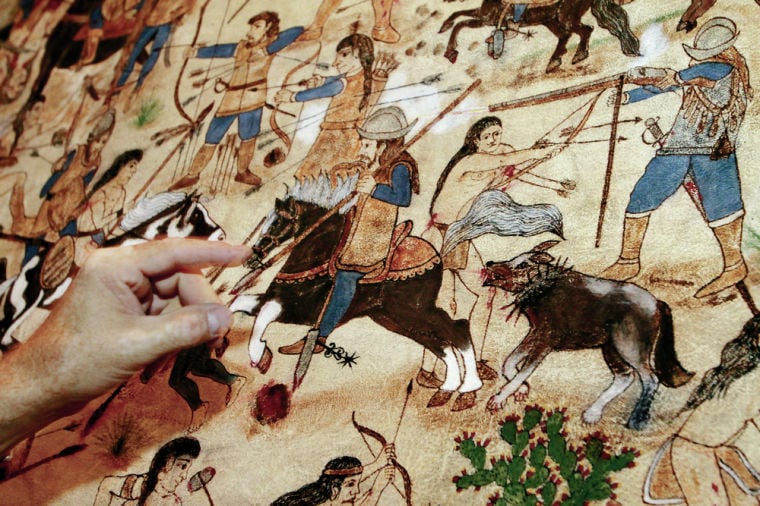
    Santa Fe is well known for its homage to the arts with its museums, studios, opera, theatre and concerts. One of the main Santa Fe art attractions every summer is the Spanish Colonial Art Market, which was held on the last weekend of July 2013. The Spanish Art Market is held at the Santa Fe Plaza, one block west of Saint Francis Cathedral, and along the adjoining streets. It is the largest art sale of its kind in North America. It features over 300 vendors of traditional Spanish colonial art, with an emphasis on Catholic religious iconography. It is an art form that traces its roots back to the Spanish settlers of Northern New Mexico and Southern Colorado some 300 years ago. Separated by geography, climate and hostile Native American tribes from their Catholic friars and neighbors, the Spanish settlers developed their own, unique religious art to help sustain their Christian faith. The original art was used to decorate their churches and moradas, and was displayed in community processions on particular Catholic religious feast days. Many of these feast days were in honor of Catholic saints, so much of the art work then as well as today falls under the category of santos, images of saints, either bultos, carved sculptures painted or unpainted or retablos, colorful wooden panels of saints. Artisans who do these art pieces are called santeros. Many contemporary santeros were taught their craft by older family members who in turn learned from their santero ancestors. In some families the santero art tradition dates back to the original settlers of the New Mexico territory. In addition to bultos and retablos, other notable art forms that have descended from the Spanish settlers of the New Mexico territory include paintings on buffalo or deer hide, colcha embroidery, straw applique, copper engraved panels, tin carvings, bone carvings, ironwork, hand made furniture and weaving. All of these art forms are on display by vendors at the Spanish Art Market. Indeed at the recent 2013 Spanish Art Market, the Blue Ribbon Best of Show selection was a painting on buffalo hide by Ramon Jose Lopez, entitled "In Un Sueno de Santa Fe, Agosto 1680".  Ramon Lopez's painting painstakingly depicts the Pueblo Indian Revolt of 1680 which drove the Spanish Conquistadors and Franciscan Friars back to Mexico. The tapestry reveals all the cruelty of war. Upon questioning, Mr. Lopez stated that he wanted to make a piece that would educate people as to what actually happened during the revolt - namely that a real war broke out between the Pueblo tribes and the first Spanish inhabitants of Santa Fe. The  tapestry is made of 4 buffalo hides stitched together with sinew and measures 8 by 16 feet. The paints are all derived from traditional New Mexico pigments. I thought the painting would best be displayed in the Historical Museum of New Mexico or at the Smithsonian but Mr. Lopez suggested that it may find its place hung in a New Mexico Catholic Mission Church. Ramon Jose Lopez's buffalo hide painting was just one of many art works at the Spanish Art Market that captured my attention. It was a delight discussing the art first hand with the various artists. I was impressed that many of the artists felt that their art had enriched their Catholic faith - had increased their reverence of Jesus Christ, Our Lady of Guadalupe and the saints. Catholic pilgrims interested in the rich Catholic culture of New Mexico should plan to visit the Spanish Colonial Art Market on the Plaza in Santa Fe during the last weekend in July each summer. Come and learn about our Southwestern Catholic heritage.


    Sunday, August 25, 2013

    Schola Cantorum of Santa Fe

                .                                                                                                                                                            The Schola Cantorum of Santa Fe, a capella sacred - music ensemble group, sang both Vespers and the Mass in Gregorian Chant on a recent Sunday evening at San Miguel Mission in Santa Fe. For more than 20 years the Schola Cantorum has been sharing the sounds of sacred music masterpieces in the chapels, missions, cathedrals and basilicas of New Mexico and Colorado. The Schola Cantorum was founded by Dr. Billy Turney in 1990. Dr. Turney was the principal organist and music director of the Saint Francis Cathedral in Santa Fe from 1990 to 2005. Turney studied Gregorian chant and polyphonic music of the Renaissance in Rome at the Pontifical Institute of Sacred Music and has the unique perspective of presenting sacred music pieces in their original context. In addition to singing the ordinaries of the Mass at San Miguel Mission, the ensemble sang Salve Regina at the offertory and Pange Lingua at communion.

    Listening to Schola Cantorum reminded me that Gregorian chant has no accompaniment, no instrumentals; it is plainchant performed by a single voice or many voices. The rhythm is very free and there is much room for pitch improvisation. The language is Latin except for the Kyrie sung in ancient Greek. The Schola Cantorum exuded a secure and confident love of Gregorian chant. There was nothing either self conscious, packaged or artificial about their performance. Their Gregorian chants were not of the commercial cross-over kind recently popular. Instead they sang true to the liturgy. Their sound was simply put - sacred. As Schola Cantorum sang their Gregorian chants, I was moved to devotion and prayer to our Lord, Jesus Christ. I would encourage all Christian pilgrims to the Southwest to seek out a concert by Schola Cantorum of Santa Fe, particularly their Gregorian Chant Mass.


    For Schola Cantorum of Santa Fe's schedule of events, click on

    Schola Cantorum of Santa Fe, New Mexico - Sacred Music of the ...

    schola-sf.org/


    Sunday, August 18, 2013

    Latin Mass

    When I attended the 2 P.M. Mass on a recent Sunday at San Miguel Mission in Santa Fe, I thought that I had traveled back in time to an earlier decade before 1962 when the Mass was almost universally celebrated in Latin. To my surprise the Mass at San Miguel was in Latin with the priest facing the tabernacle and not the congregation. Although I had trained as an altar server for the Latin Mass in the early sixties and had studied Latin for 4 years in the mid sixties at Bellarmine, a Jesuit high school in Tacoma, my Latin these days is very rusty so I had difficult keeping pace with the liturgy. Certain Latin phrases such as "et cum spiritu tu o" are easy to remember and the" Agnus Dei" is often cited in mixed English- Latin Masses. For other responses and prayers I needed to use the Latin- English Missal Guide in the pews. What struck me most about the rendition of the Latin Mass was the seemingly large number of blessings and genuflections performed by the priest. Also those receiving communion knelt at the altar rail and took Communion on their tongues - just as practiced when I was an altar server. I remember holding the patent to prevent the Eucharist from dropping on the rail or the floor. The women in attendance at San Miguel Mission all wore scarves or hats and some wore veils. The congregation was also older than at the English Mass I attended at San Miguel Mission although there were a number of college age students. My general impression of my first all Latin Mass in 50 years was favorable. The Latin liturgy is beautiful to hear as Latin is a very vowel heavy language, albeit different than  the melodious vowel tones of a Hawaiian Mass I once heard. Spoken Latin sounds like a sacred language so I would imagine that a Latin Mass would be especially appropriate for a wedding or an ordination to invoke the sanctity of those events. I also found San Miguel Mission, an ancient church, ideal for this liturgy. Again I will admit that despite my Latin background I couldn't always keep up with either the prayers or the responses but I presume that regular attendees at the Latin Mass become very familiar with the Latin phrases and their translations.  Also it was difficult to see exactly what the priest was doing with his back to us. I wondered whether the Latin Mass couldn't be celebrated with the priest facing the congregation.
     Upon returning home that evening I was curious - why had the Latin Mass all but vanished in the sixties and was it making a comeback? The Latin Mass has also been known as the Tridentine Mass, which is the form of the Roman Rite Mass, contained in the typical edition of the Roman Missal that was published from 1570 to 1962, promulgated originally at the Council of Trent. In 1962  permissions were granted from Pope Paul VI to celebrate the Mass in vernacular languages. Subsequent liturgical reforms of the Second Vatican Council from 1962-66 encouraged a wider participation of the laity in the liturgy of the Mass. The priest was to face his congregation to make the Mass more relevant and to encourage the laity to join in prayers and liturgical responses.  The Roman Missal was translated into modern languages also to enhance understanding of the liturgy. In 1969 the Mass of Pope Paul VI was introduced and officially replaced the Tridentine Mass. It was to be celebrated in the popular languages of the congregations. I will mention that neither the Second Vatican Council nor the subsequent revisions of the Roman Missal abolished Latin as the liturgical language of the Roman Rite. Indeed the official text of the Roman Missal continues to be in Latin. After 1969 permission to celebrate the Tridentine Latin Mass had to be granted by the local ordinate and was reserved for unique liturgical occasions. As an older generation of priests versed in the Latin Mass retired, they were replaced by a younger generation of priests without any training in the Latin Mass. In some respects the Latin Mass went away with the attrition of the previous generation of priests.  Also the fervor from the Vatican Council for the modern Mass of Paul VI led to the restrictions placed on the classic Tridentine Latin Mass. The 'times were also changing' in the Catholic Church in the sixties.
    Yet the Latin Tridentine Mass still had its advocates. Traditionalist Catholics, who rejected some of the reforms of the Second Vatican Council, such as the move away from the Latin Mass, either broke from the Catholic Church altogether or sought relief from their Bishops for the celebration of Latin Masses. Those who separated from the Vicar in Rome, such as Archbishop Marcel Lefebrve of France, were excommunicated. Those who remained within the Catholic Church and who attended approved Latin Masses continued to petition the Vatican for a relaxation of the restrictions placed on celebrating the Latin Mass.  In 2007, Pope Benedict issued an Apostolic Letter "Summorum Pontificum" liberalizing the approval for celebration of the Latin Mass. He encouraged Bishops to make the Latin Mass more available upon requests by the faithful. Indeed the Latin Mass at San Miguel Mission was officially approved by Archbishop Michael Sheehan in 2008 in  response to a petition from some of the faithful in Santa Fe, Los Alamos and Espanola. I was informed that attendance at the Latin Mass at San Miguel has steadily increased since its inception.
    I encourage Catholic Pilgrims to attend a Latin Mass. The Latin Mass isn't meant to replace the Mass of Paul VI, yet it has its own unique beauty and sacredness. It is the Mass our parents and grandparents celebrated. The Catholic Mass in New Mexico, whether celebrated in English, Spanish or Latin has always been a summons for us to encounter Christ and to become the holy people of God.


    To read Pope Benedict's "Summorum Pontificum" click on

    Summorum Pontificum 

    www.vatican.va/.../hf_ben-xvi_let_20070707_lettera-vescovi_en.html