Friday, May 31, 2013

9/11 Memorial at Sacred Heart Catholic Church in Barelas


I recently attended the funeral mass for Father Jim Moore at Sacred Heart Church in the Barelas neighborhood, just south of downtown Albuquerque. I knew Father Moore when he was an associate of the Blessed Sacrament clergy at St. Charles Borromeo parish and would celebrate the 7 A.M. early Mass. During his previous tenure as pastor of Sacred Heart Parish from 1996 to 2006 , Father Jim was a witness to the transformation of the Barelas neighborhood from drugs, gangs and graffiti to art murals and newly painted homes. As part of that transformation Father Moore and his parishioners established  a 9/11 Memorial in Sacred Heart Church. Steel girders, each 30 feet in length, were brought from the ruins of the World Trade Centers in New York to the Sacred Heart Church in Barelas in 2003. The parish raised $250,000 to build a  towered belfry to house the beams. That belfry today stands atop the Church like a sentinel. The beams were blessed by Father Moore before they were trucked from New York City and again by Archbishop Michael Sheehan upon their arrival at Sacred Heart Church. In the belfry these sacred steel shards have been placed against each other to resemble a cross. Also on display is a wall of engraved granite listing the names of all those who were murdered on 9/11. There is a copper-plated book with names and biographical entrees for each of the deceased. There is a New York State flag, a t-shirt signed by 9/11 rescue workers, a New York City firefighter's helmet and police hats. On the wall facing the steel beams is a religious icon - it depicts the Madonna with her arms encircling the tall World Trade Center towers as twin engine jetliners circle overhead.  Next to this icon stands a shrine statue of Our Lady of Guadalupe with an adjacent kneeler for prayers.  With arms out she seems to be calling visitors to prayer.
The 9/11 Memorial at Sacred Heart Church in Barelas is both a National and a Catholic shrine. It is a place to reflect on the tragedy that struck our nation that day, the innocent loss of life and the suffering of the victims and their families and friends.  It also recalls the individual acts of heroism by police, firemen and other first responders who made the ultimate sacrifice to save the lives of others. The setting of this 9/11 Memorial at Sacred Heart Church enables us to honor the victims and their families with our prayers. It also calls us to contemplate Christ's teachings on forgiveness: Matthew 18:22 - Then Peter came up to Him and said, 'Lord, how often shall my brother sin against me and I forgive him? As many as seven times?' Jesus said to him, 'I do not say seven times but seventy times seven.'  In other words Jesus is telling us that we must always forgive. Even in the face of a grave injustice causing great harm- like 9/11? Listen to the words of Jesus on the cross: Luke 34 - 'Father, forgive them for they know not what they are doing.' Jesus asked His Father to forgive His tormentors and those who crucified Him even though at the time most were unrepentant.  To forgive is not to forget. Indeed the 9/11 Memorial helps us to remember the injustice of that date.  It's just that there is no place for hatred and vengeance when we understand that we belong to God - who has already forgiven us 'seventy times seven'.


Listen to this sermon from Father Robert Barron on 9/11 and forgiveness:


Shrine of The Stations of the Cross - San Luis, Colorado


While driving from Denver to Albuquerque, I stopped in San Luis De La Culebra, Colorado just north of Questa, New Mexico to visit Colorado's newest Catholic Shrine - La Mesa de la Piedad y de la Misercordia (Hill of Piety and Mercy). The  shrine's two centerpieces are The Stations of The Cross and La Capilla de Todos Los Santos (The Chapel of All Saints) . The Stations of The Cross are 15 bronze sculptures, depicting the Passion, Death and Resurrection of Jesus Christ, winding up the Hill of Piety and Mercy to the adobe Chapel of All Saints. Each station is strategically placed along a 3/4 mile ascending trail to look out over the San Luis Valley and to the Sangre de Cristo Mountain range. The stations were sculpted by a local artist Huberto Maestas in 1986. The Chapel of All Saints is a domed adobe structure resting atop the Hill of Piety and Mercy and visible across the San Luis Valley.  Local architects, Arnold Valdez and Milton Bertin designed and supervised the construction of this elegant Spanish - Moorish styled church. Catholic families from the Sangre de Cristo Parish of San Luis, many of whom trace their ancestry to the original Spanish settlers who farmed and ranched the San Luis Valley by right of a land grant from Spain, donated the building fund for the Shrine.
The Stations of the Cross are by themselves well worth the visit to San Luis, Colorado. Huberto Maestas's statues embrace drama and emotion and capture the sense of movement up the Hill of Piety and Mercy - a San Luis version of Golgotha. The statues are 2/3 life size with the exception of the life size Crucifixion and Resurrection near the top of the mesa. Each statue is meticulously detailed, down to the folds of clothing, and the sharp thorns protruding from the crown of thorns Jesus wore. Most memorable are the expressions on the faces of Jesus, His mother Mary, His followers and tormentors. In successive stations, Jesus' face reveals sorrow, suffering, resolve and compassion. On the last station, the image of the Resurrection, Jesus' face glows with rapture as he points upwards to Heaven. Each station is positioned next to a large bronze plaque, anchored in concrete, bearing the name of the station and the corresponding Bible verses in both Spanish and English. Benches allow the visitor to rest and meditate on the impact of each station. On Friday afternoons during Lent, the priest from the Sangre de Cristo Parish leads parishioners as well as visitors in The Stations of The Cross by walking the Hill of Piety and Mercy. On Good Friday most of San Luis's residents turn out for a procession up the path of The Stations of the Cross and on Easter Sunday, a Lenten veil is removed from the 15th Station to celebrate Christ's Resurrection.


La Capilla de Todos Los Santos ( The Chapel of All Saints) perches atop The Hill of Piety and Mercy and can be seen across the San Luis Valley, conveying a certain Catholic religiosity to this agricultural setting. The Chapel was finished and dedicated in 1997. The Spanish-Moorish architecture suggests an antiquity belying its real age. The walls are thick adobe and whitewashed. Two steeples and a dome afford elegant balance to the building's exterior. The interior of the chapel is remarkable for its simplicity. The wood pews were hand carved and the aisle rug was hand woven by local artisans. On the afternoon I visited, sunlight streamed in thru the porthole windows on the apse wall. An Icon of the Madonna and her Child adorned the south wall. A hand carved Crucifix and Retablos graced the sacristy. The Chapel of All Saints conveyed sacred solitude and peace, commensurate to its location on a hilltop above the Stations of the Cross Shrine.


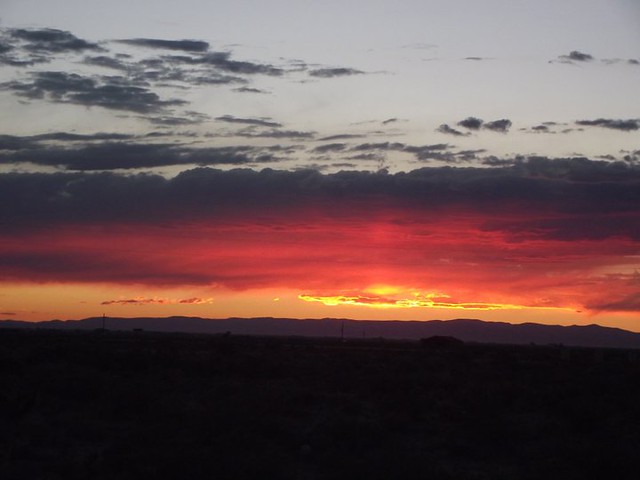
I left the town of San Luis in the evening and drove south down the length of the San Luis Valley to the New Mexico border.  The sun was descending over the mountains in the west. It was one of those classic Sangre De Cristo sunsets - rose red then dark red. It reminded me of Willa Cather's description of the Sangre De Cristo Mountains, "those red hills, never become vermilion, but a more and more intense rose carnelian, not the colors of living blood, but the color of the dried blood of saints and martyrs." Indeed the Franciscan Padres initially traversed these mountains and valleys in the late sixteenth century, bringing Christianity to the Native American tribes. Most were martyred for their efforts. A second wave of Franciscan Padres came up the Camino Real in the 17th century and brought Spanish settlers with them. The legacy of those early Franciscan missionaries is evident in the Catholic religious symbolism that is integral to life in the San Luis Valley. The Shrine of The Stations of The Cross is one of those symbols. It is a place where the Christian faith is still prominent, where Christian and other religious pilgrims are welcome to visit. 

Watch a video of the San Luis Shrine by clicking

Local Tourist Colorado - San Luis and Stations of the Cross - YouTube

www.youtube.com/watch?v=B1zqm-C0T_Q


► 5:43► 5:43
www.youtube.com/watch?v=B1zqm-C0T_Q


Sunday, May 26, 2013

Cathedral Basilica of the Immaculate Conception in Denver


                                                                                                                                                  During a recent stay in Denver, Colorado, I was able to attend the noon-day Mass at the Cathedral Basilica of the Immaculate Conception which is situated in downtown Denver near the state capitol. Although 250 miles from New Mexico, Denver shares a common Catholic history with its southern neighbor as it was originally within the Territory of New Mexico and under the auspices of the Archdiocese of Santa Fe. Indeed the Very Rev. Joseph P. Machebeuf, the first bishop of Denver and the Colorado Territory, was a lifelong friend of ArchBishop Jean Baptiste Lamy of Santa Fe and had been recruited by Lamy in 1851 to follow him from Ohio to Santa Fe to serve the new Archdiocese of Santa Fe which at that time included the future states of  Arizona, Colorado and New Mexico. As gold and silver mines and the railroad brought more settlers to Denver and the Colorado Territory, Colorado was established as an independent vicar apostolate in 1875 with its own Bishop.

The Cathedral Basilica of the Immaculate Conception was dedicated on October 27, 1912, consecrated in 1921 and was elevated to minor basilica status in 1975. On August 13 and 14 of  1993, His Holiness, Pope John Paul II, celebrated masses at the Cathedral Basilica as part of the celebration of World Youth Day. Today the Cathedral Basilica of the Immaculate Conception serves as the mother church of a faith community of approximately 500,000 Catholics spread amongst 144 parishes and missions in Northern Colorado. The Cathedral houses the kathedra ( chair), from which the Archbishop carries out his duties to the Archdiocese of Denver as teacher and shepherd. The Cathedral has also been designated a Southwestern Shrine Church attracting pilgrims to its liturgical services.
The cruciform Cathedral was inspired by French Gothic architecture. The Cathedral is 195 x 116 feet in length and width with a vaulted ceiling rising 68 feet above a slightly sloping nave. The bell spires were capped at 210 feet in 1912. The east spire contains 15 bells. The foundation is made of Gunnison granite, the exterior walls of Indiana limestone and much of the interior structural marble from Marble, Colorado. The finest Carrara marble from Italy was used for the altars, the pedestal, the pulpit, the statues, the communion rail, and the Bishop's throne. The front doors are made of brass and show the papal insignia miter with two keys. Busts of 19th century popes and the baptismal font are on the east side of the vestibule and a statue of Saint Anthony of Padua is on the west side of the vestibule.
The outstanding feature of the Cathedral Basilica of the Immaculate Conception are the 75 stained glass windows - more than any other church of any denomination in America. The windows were crafted by F.X. Zettler, a chemist known for his use of beautiful dyes in making stained glass at the Royal Bavarian Art Institute of Munich, Germany. He oversaw 50 artisans in the production of the windows for the Denver Cathedral in 1912 and considered these windows the finest of his tenure at the Bavarian Art Institute.
The other work of art worth noting is the W.W. Kimball pipe organ filling the choir gallery. The pipe organ has 31 speaking registers embracing every known tone-color of organ voicing and also contains the speaking registers for vox humana, which closely resembles the tones of the human voice. While I was visiting the Cathedral, a visiting organist was teaching a class of local students and the music was heavenly.
The weekday Mass I attended was populated with a few young mothers and  their children, some elderly women, men in business suits and a few visitors like myself. The visitors were easy to pick out as they were marveling at the stained glass windows. In particular I was struck by the colors of the large west transept stained glass window depicting the formal proclamation of the doctrine of the Immaculate Conception by Pope Pius IX in 1854 and by the rose window behind the choir loft depicting angels above us.  The window colors had a transcending quality, exposing a small glimpse of the vivid brilliance of God's kingdom. I had entered the Cathedral  with some apprehension about medical tests I had undergone earlier that morning. I would be meeting my physician in the afternoon to learn if I was responding to treatment. Inside the Cathedral my attention was drawn to the artistic beauty of this house of God and I stopped worrying about my pending doctor's visit. I was pleased that I was there, celebrating the Mass with my fellow Catholics in this magnificent Cathedral..
The Cathedral Basilica of the Immaculate Conception is definitely worth a side trip to Denver for New Mexico Catholic pilgrims. See for yourself.


West Transept Window


Rose Window

For more information on the Cathedral Basilica of the Immaculate Conception please click on

The Cathedral Basilica of the Immaculate Conception

www.denvercathedral.org/

Monday, April 29, 2013

Aquinas Newman Center - University of New Mexico


 My first visit to a Newman Center was in 1970 when I was an undergraduate at the University of Washington. I was seldom attending Mass then. It wasn't that I had rejected Christianity just that I was ignoring my faith. Although I was a science major, I sampled courses in philosophy, anthropology, history and American literature and just didn't encounter mention of Christianity.  In lit classes we somehow didn't read Flannery O'Connor. I also wasn't aware of theology course offerings at UDUB. My Catholic undergrad friends never discussed their faith. Practicing Catholicism seemed inconvenient until I needed God's help. In 1970 I was devoting most of my study time to a very difficult organic chemistry class and was preparing to sit for the MCAT exam. I seemed to be unsure of my academic performance for the first time in my college life so I decided to attend Sunday Mass at the Newman Center for the purpose of requesting  the Lord's assistance in my study and exam efforts. The Newman Center Chapel was on the North side of campus on 17th street in the midst of fraternity row. What I remember about that service was how avidly the Newman Center Catholic students worshiped and enjoyed the celebration of the Mass. When I walked back to my dormitory I realized that I had lapsed in practicing my Catholic faith as an undergrad at the University of Washington. The following week I received the sacraments of Reconciliation and the Eucharist. In large measure owing to my Newman Center experience, I committed myself to a more active prayer and sacramental life for the remainder of that academic year. Returning to my Catholic faith returned to me a sense of confidence and optimism about my remaining academic goals that year.
The concept of Newman Centers was inspired by the British theologian and convert to Catholicism, Blessed John Henry Newman, who wrote in the 1800's that "religious truth is not only a portion, but a condition of general knowledge." His inspiration led to the founding of the first Newman Club at Oxford University in1888. The initial Newman Club and all subsequent Newman Centers have provided Catholic ministries to Roman Catholics on non-Catholic University campuses. Christians of other denominations have always been welcomed to attend services. In addition to Catholic liturgies, a variety of university and parish related social events take place at the Newman Centers.
The Aquinas Newman Center at the University of New Mexico was established on Las Lomas Road on UNM's campus in 1950 and the current chapel was built in 1954. The lounge and meeting hall were built in 1957. Dominicans were recruited to serve as clergy for the Newman Center at UNM when it opened and fulfill that role today. The Newman center has been recognized as a parish of the Archdiocese of Santa Fe and currently serves more than 1000 families in addition to UNM students, staff and faculty. The parish mission statement says that the primary mission of the Newman Center is to "embody Christian principles through cooperative ministry with the academic community and alumni of the University of New Mexico". The Newman Center also houses the Dominican Ecclesiastical Institute, which seeks to promote Catholic intellectual life in the tradition of the Dominican order, through public discourse and media offerings. The DEI sponsors the bi-monthly Catholic Business Forum, offers Catholic theology education as well as media resources for exploring the Catholic faith. The Newman Center also maintains a theology library open to its parishioners and the university community.
The Sunday evening Mass I attended at the University of New Mexico Newman Center was specifically targeted to the student community. The chapel was packed, predominantly with students.  There was an excellent student choir conducted by the Newman's Center director of music. Students also served as acolytes and lectors. The announcements at the end of the Mass included information on a future baccalaureate Mass and an upcoming John Angotti concert at the Newman Center. I was impressed with how enthusiastically the students participated in the liturgy, both in prayers and in song. They seemed to be a very committed Catholic community, excited about their faith. When I left the UNM Newman Center I experienced a deja vu to that evening 40 plus years ago, when I attended Mass at the Newman Center near the University of Washington campus. Again I felt reinvigorated to practice my Catholic Christian faith and hopeful for the future. I encourage Catholic pilgrims, particularly Catholic university students to visit the Newman Center, an oasis of spirituality within the University of New Mexico campus - definitely a place to reconnect to one's Catholic faith.
For a Newman Center Promo vimeo click on

Newman Promo Video on Vimeo

vimeo.com/20104379


For information on the Aquinas Newman Center at UNM click on

Aquinas Newman Center - Home - Albuquerque

www.aquinasnm.org/


Sunday, April 14, 2013

Easter Triduum Vigil at John XXIII Catholic Church


The Easter Vigil liturgy is the most beautiful liturgy of the Roman Catholic Church, particularly as celebrated in full splendor at John XXIII Catholic Church in Albuquerque. This Holy Saturday evening Vigil marks the beginning of Easter. The service is divided into four parts: 1. Service of the Light  2. Liturgy of the Word  3. Liturgy of  Baptism   4. Liturgy of the Eucharist.  In the service of the light the Church is dark, the holy water fonts are empty and the tabernacle is empty. The service begins outside the church where a new fire is lit and blessed. A Paschal candle is prepared with these words, 
" Christ yesterday and today, the Beginning and the End, Alpha and Omega, all time belongs to Him, and all the ages to Him be glory and power through every age forever. Amen" Father Ark lit the candle from the new fire, saying " May the light of Christ, rising in glory, dispel the darkness of our hearts and minds."  The candle was then carried back to the Church, with the Deacon lifting the candle three times and singing, " Christ our light (Lumen Christi)" and the congregation singing in reply, " Thanks be to God, ( Deo Gratias)." The congregation then lit their candles from the Paschal candle and the whole church was alight. The Paschal candle symbolizes Christ, the Light of the world.
Next followed the glorious Easter song of the Catholic Church, the Exsultet, sung by the Deacon. This hymn, remarkable for its symbolism and lyricism, announces the meaning of Easter; it tells of man's sin, of God's mercy and of  the Redeemer's great love for mankind, admonishing us to thank the Trinity for all of the graces lavished upon us.
The Liturgy of the Word follows the Service of the Light. During the Easter Vigil , 9 readings, seven from the Old Testament and 2 from the New Testament were read. These readings help us meditate on the wonderful works of God for His people since the beginning of time. The readings are: 1. The story of creation, Gen 1: 1-2;   2. Abraham and Isaac, Gen 22; 1-18   3. Crossing of the Red Sea, Exodus 14: 15-15:1   4. Isaiah 54: 5-14   5. Isaiah 55: 1-11   6. Baruch 3: 9-15, 32-4:4  7. Ezekiel 36:16-17; 18-28   8.Romans 6: 3-11   9. Mark 16:1-7
 During the Liturgy of Baptism, the Easter water was blessed and new members were brought into the Church through the sacrament of Baptism. New adult members were immersed in the baptismal pool with Father Ark  presiding. After the new members were baptized, the faithful were blessed with water and renewed their baptismal promises.
During the Liturgy of the Eucharist , the Mass resumed with special prayers inserted during the Eucharistic Prayer. The whole church was called to join at the sacrificial table that Christ prepared for us through His death and Resurrection. The Mass ended with the proclamation from Father Ark, " The Mass is ended, go in peace, alleluia, alleluia." The faithful responded, " Thanks be to God, alleluia, alleluia!"
It was late when the Easter Vigil concluded, near midnight. There was silence as we filed out of John XXIII Catholic Church. The stars seemed brighter that evening. Christ had Risen.
 
 
To listen to a recording of the Exsultet, click on

Exsultet - YouTube

www.youtube.com/watch?v=Qkle6URiM4sShare


Sunday, April 7, 2013

Easter Triduum - Good Friday at John XXIII Catholic Church


I attended Good Friday vigil services at John XXIII Catholic Church in Albuquerque. On Good Friday, Catholics focus their attention on the Cross at Calvary. In the solemn rituals of Good Friday - in the veneration of the Cross, in the chanting of the Reproaches, in the reading of the Passion and in receiving the pre-consecrated Eucharistic Host, Catholics contemplate the cost of Christ's redemption. The church is in a state of mourning - the altar is bare, ornaments have been removed and the door of the empty tabernacle is open.  In the first liturgical ceremony, the veneration of the Cross, Catholics recite the ancient praise, "We adore Thee, O Christ, and we bless Thee because by Thy Holy Cross Thou has redeemed the world." A representation of the Cross is raised up on the altar steps and each member of the congregation is invited  to the altar to genuflect and kiss the cross. By reverencing the Cross, Catholics acknowledge  that it is inseparable from Christ's sacrifice and so we are in essence reverencing Him. The next liturgy, the chanting of the Reproaches, occurs during the veneration of the Cross. In this ancient hymn or chant, Christ reproaches us for our sinfulness and the hardening of our hearts to God, necessitating His crucifixion for our redemption. Next in the liturgy of Good Friday, the Passion of Christ is read. At John XXIII, Father Ark read Jesus' words and parishioners read the narration and other parts - a reflection that we all share in the guilt of Christ's Passion. The final part of the liturgy is the distribution of the Eucharist consecrated on Holy Thursday and kept in the Blessed Sacrament Chapel until it is brought into the main Church for communion during the Good Friday vigil. By receiving the consecrated body of Christ we share in the final glory of the crucifixion. We awaken ourselves to His Resurrection on Easter.
 
For a video of Pope Francis at St. Peter's Basilica in Rome on Good Friday 2013, click on

Pope Francis honors Jesus' Passion on Good Friday Service - YouTube

www.youtube.com/watch?v=n2P6EBnvyZkShare


Saturday, April 6, 2013

Easter Triduum - Holy Thursday at John XXIII Catholic Church


Season of SpringLast week I attended Easter Triduum services at John XXIII Catholic Church in the Northeast Heights of Albuquerque. John XXIII Catholic Community was founded by Father Arkad Biczak in 1978 when the Northeast Heights was mostly sage and the main thoroughfare, Tramway, was a dirt road. The Church's original home was the gymnasium at the nearby Eldorado High School when it served the burgeoning Northeast Heights population.
 As the Northeast Heights population boomed, the current church was built at its location off Manitoba and Tramway Ridge. The Church is truly a Vatican II Catholic community, encouraging lay participation in the sacred liturgies as well as in all of its Christian ministries, pastoral council and governing committees. Its constitution states that it is a Vatican II concept of Christian community and mission. The church was named John XXIII in honor of the Pope who called for and opened the Second Vatican Council.
The crowning architectural feature of John XXIII Catholic Church is the blue dome constructed of laminated glued timbers  and supported by steel trusses. The 60 foot glulam dome rises 38 feet and weighs some 30 tons. It provides the church with most of its natural light, the remainder coming from the tall stained glass windows on either side. The windows depict some of the famous landscapes of New Mexico: Jemez Mountains, Truchas Peaks, the Brazos Canyon, Nambe falls and the Southern New Mexico dessert. In deference to the Native American cultures of the Southwest,  a chalice and water pitcher sit on a Navajo blanket in one of the scenes.

Holy Thursday Vigil is the first sacred ceremony of the Easter Tridium. It is the day on which Christ celebrated the Last Supper with his disciples, 4 days after His triumphal entry into Jerusalem on Palm Sunday, Only hours after the Last Supper, Judas would betray Christ with a kiss in the Garden of Gethsemanee, setting the stage for His crucifixion on Good Friday.
At John XXIII, Father Ark and 12 male parishioners  wearing the garments of Christ's time, sat at a table facing the congregation in the Church and reenacted both the Passover meal and the Last Supper, connecting the Old Testament Covenant to the New Testament Covenant. For Catholics, the Last Supper commemorates three pillars of the Catholic faith: Holy Communion, the Mass and the priesthood. During the Last Supper, Christ blessed the bread and wine with the very words that Catholic priests use today to consecrate the Body and Blood of Christ. In telling His disciples to "Do this in remembrance of Me."', Catholics believe that He Instituted the sacred Mass and made His apostles the first priests.  During the Last Supper, Christ also washed the feet of His apostles and said to them, "A new commandment I give unto you: That you love one another, as I loved you, that you love one another."
During the Holy Thursday ritual, Father Ark recited these words of Christ and washed the feet of his designated apostles, who in turn went out into he congregation to wash the feet of church attendees, symbolizing Christ's message of service and humility.. After the washing of the feet, the Mass of the Lord's Supper was celebrated and ended when the Eucharist was carried in procession to the Blessed Sacrament Chapel where it was to be kept overnight until its distribution during the commemoration of the Lord's Passion on Good Friday. At the conclusion of the Mass, the faithful were invited to continue adoration of the Blessed Sacrament through the night, just as Christ's disciples were invited to continue their prayers with Him in the Garden of Gethsemane on Holy Thursday night.
This Holy Thursday service at John XXIII Catholic Church was a very symboloic, solemn and sacred vigil, beckoning Catholic pilgrims. It  anticipates the next observance of the Easter Triduum  - Good Friday.


For more information on Holy Thursday click o the link -

Holy Thursday - Easter / Lent - Catholic Online


www.catholic.org/clife/lent/thurs.phpCached - SimilarShare
 
 For inspiring  respones to Pope Francis recent washing of the feet of detention inmates on Holy Thursday, click on