

On the first Monday evening of every month, the Benedictine monks hold a healing service in Our Lady of Guadalupe Chapel at the Pecos Benedictine Monastery. The Benedictines incorporate Taize prayer into this service. In Taize prayer, single musical phrases with simple melodic units are sung communally. The repetitive nature of these songs echoes more traditional modes of prayer such as the Jesus prayer. There is a spirit of silence and reflection during Taize prayer as participants strive to open their hearts to the Spirit. Those who come to the healing service are asked to bring their loved ones, their concerns for the world, for friends and family members, for their communities, and their own cares and needs. Most importantly they are invited to open their hearts and hands to God so that the spiritual power of simple melodies and praise words will wash over their souls and bring healing.
At the Monday service I attended Father Bob Lussier presided and asked the convocation to pray for healing of drug and alcohol addiction within their families and the larger Pecos community. He asked for prayer invocations to end domestic violence incidents and the recent tide of suicides in Pecos. He then called for individual prayer intentions and many of those attending spoke sincerely of the need for healing within their families. Father Lussier then read from Mark's gospel, some of the accounts of Jesus' healing power. My favorite, testifying to the divine omnipotence of Jesus Christ is Mark 8, 54-56, "As they were leaving the boat, people immediately recognized Him. They scurried about the countryside and began to bring in the sick on mats to wherever they heard He was. Whatever villages or towns or countryside He entered, they laid the sick in the marketplaces and begged Him that they might touch only the tassel on His cloak; and as many as touched it were healed." After the scripture readings, Father Lussier then asked the congregation to join him in Taize prayer hymns, following which each participant was then asked to come forward for the Anointing of the Sick. The celebration of this sacrament consists essentially in the anointing of the forehead and hands of the sick person with oil blessed by the bishop, accompanied by the liturgical prayer of the celebrant asking for the special grace of the sacrament to be conferred on the anointed. This special grace has the effects of uniting the sick person to the passion of Chris, affords the strength, peace and courage to endure in a Christian manner the sufferings of illness or age, offers the forgiveness of sins, the restoration of health, if conducive to he salvation of the soul, and for the dying the preparation of passing over to eternal life. Devotional candles were then lit and placed on a wooden cross in front of the altar, where the congregation knelt to offer their own personal prayers to God. The service ended with a blessing from Father Lussier and with an invitation to evangelize their communities. As I drove back to Albuquerque, I was grateful for the mission of the Benedictines at Pecos, for their efforts to bring spiritual salvation to that community, and for the peace and trust in God I experienced that evening.
To link to the healing service at Pecos Benedictine Monastery, click guestmaster@pecosmonastery.org
Subscribe To

 Posts
All Comments
Posts
All Comments
Saturday, March 22, 2014

Wednesday, January 29, 2014
San Juan Diego Friary in Albuquerque
 The Franciscan Friars of the Renewal have been following in the footsteps of Saint Francis since the inception of their order in 1987 in the Bronx, New York. The community is comprised of men who desire to live the rule of Saint Francis of Assisi in the Capuchin Franciscan tradition. Their mission statements are to serve the spiritual and material needs of the poor and to work for the reform of the Catholic Church through the evangelical preaching of personal reform. In Albuquerque they have opened the San Juan Diego Friary at 404 San Mateo N.E, which houses Fray Antonio's soup kitchen, providing a warm lunch meal every Wednesday to both the homeless and the poor in adjacent neighborhoods, The Friars also conduct youth retreats, substitute at parish masses for diocesan priests, hear confessions, are prolife advocates and do street evangelization. The friars currently residing at San Juan Diego Friary include Father Joseph Mary Deane, C.F.R., Brother Maximillian Mary Steimachowski, C.F.R., Father Daniel Marie Williamson, C.F.R., and Father Terry Messer, C.F.R.. The friary has private living quarters for the friars, a small, simple chapel where Mass is celebrated at 730 am on weekdays, a prayer room, a large communal dining hall graced by paintings of Saint Francis, Our Lady of Guadalupe and the Nativity scene, a kitchen almost as large as the dining hall, where meals are prepared and dishwashing is done by volunteers, and a smaller dining hall behind the kitchen where the friars eat their meals. There is also a bathroom with a shower stall equipped for handicap persons just down the corridor from the mess hall. The friars have also built a patio with tables and chairs and a warming fire pit for persons waiting in line for the Wednesday lunch meal. The facilities are all handicap accessible. The Wednesday lunch crowd usually numbers between 200 and 300, with larger attendance near the end of the month when incomes are becoming depleted. A warm and nutritious meal is prepared for guests and there is always a choice of desserts, coffee and tea. The food is either donated by the Albuquerque food bank or purchased by the friars from discount grocers. The friary is open for Wednesday lunch at 11am and closes at 230 pm. There are adjacent bus stops on either side of San Mateo street as well as ample parking at the friary.
On the occasions when I have volunteered at the friary during the Wednesday lunch service, I have been struck by the good cheer of the friars, the volunteers and the diners. The friars are courteous and respectful to all - both visitors for lunch and volunteers. The dining hall itself is usually packed with lively conversations going back and forth between the diners as well between diners and volunteers. When visitors leave the dining hall, they will often stop to thank the volunteers and friars. Many have remarked how they look forward to returning the next Wednesday, which must make Saint Francis of Assisi pleased. In one of his earliest sermons, he is reported to have said, " All getting separates you from other men; all giving unites you to them. Oh believe me, that, once you have seen this, all getting , over and above your simplest needs, will be tainted with distress, and all giving will be a source of joy. I tell you, you do not know the joy, the liberation , and the fullness of living that will come to you if you will make this simple change of heart. The whole face of the world will change for you, taking on a new graciousness, and the face of every brother will be beautiful." And so it seems every Wednesday at San Juan Diego Friary in Albuquerque. A lot of good will flows between the volunteers and visitors who meet each other there on Wednesdays . I suspect that they feel connected despite their different economic circumstances. At least for those few hours on Wednesdays the spirit of Saint Francis lives on in this world. We can thank the Franciscan Friars of the Renewal for keeping alive the message of their founder.
To enjoy a meal or volunteer at San Juan Diego Friary, click on
To learn more about Saint Francis of Assisi, I recommend reading " In The Steps Of Saint Francis" by Ernest Raymond, copyright 1939 by H.C. Kinsey Company ( available on AMAZON)
Wednesday, December 25, 2013
Shrine of Our Lady of Guadalupe - Santa Fe, New Mexico
~
 The Shrine of Our Lady of Guadalupe in Santa Fe, established in 1777, is the oldest still standing shrine built in honor of our Lady of Guadalupe in the United States. It is an enduring landmark, commemorating the apparitions of Mary to the Aztec peasant Juan Diego at Tepeyac, Mexico between December 9 and 12 in 1531. As recorded then by the court of Bishop Fray Juan de' Zumiarraga of Mexico City, Juan Diego reported to the Bishop that he had seen a young girl, whom he presumed to be the Virgin Mary, while walking on the hill of Tepeyac, outside Mexico City and she had asked him to petition the Bishop for the construction of a church for worship of the Lord Jesus Christ. The Bishop sent Juan Diego away, asking him for proof of this apparition of the Virgin Mary. The following day, Juan Diego returned to the Bishop and said, " She sent me to the top of the little hill of Tepeyac where I had seen her before, to cut some rose flowers there ... and she told me that I should give them to you from her and in that way I would prove it. Here they are, please receive them." Juan Diego then opened his tilma (peasant cloak) and the roses spilled out. revealing a perfect, miraculous image of the Virgin on the fabric. After viewing this image, Bishop Zumiarraga approved the construction of The Church of The Virgin of Guadalupe at Tepeyac. It is reported that wihin 30 years, almost the entire Aztec nation converted to Christianity. The church at Tepeyac has been replaced by the Cathedral Basilica of Our Lady of Guadalupe, the most visited Marian shrine in the world. The original Juan Diego tilma image of Our Lady of Guadalupe is on display in the Basilica today and has decayed little over the past 483 years, defying scientific explanations. Miraculous healings of Christian pilgrims visiting the Cathedral Basilica have been reported.
 The Shrine of Our Lady of Guadalupe in Santa Fe has its own unique features. The Shrine consists of the historical chapel - the Sanctuario de Guadalupe, a new larger Church of Our Lady of Guadalupe to accommodate the burgeoning parish, the El Cerro de Tepeyac - a walking path featuring six tile mosaics by the artist Arlene Cisneros Sena, illustrating the apparitions of Our Lady of Guadalupe to Juan Diego and the newest addition, a 12 foot statue of our Lady of Guadalupe which stands in front of the Sanctuario de Guadalupe, greeting visitors. There is also a prayer station at the statue of Saint Bernadette. A rose garden with flowers from the Holy Lands in the Middle East embellishes the entrance to the Sanctuario.
The original Church of Our Lady of Guadalupe, a small adobe structure, was built in 1777 on the banks of the Santa Fe River near the end of the Camino Real. The church was constructed on a Latin cross floor plan, with thick 3 foot adobe walls, a flat roof supported by pine vigas, a dirt packed floor and a 3 tiered bell tower, Owing to disrepair the Church was closed in 1826 by Vicar Fernandez San Vicente of the Diocese of Durango, Mexico and remained closed until 1881 when Bishop Lamy of the Archdiocese of Santa Fe appointed Father De Fauri from Denver as pastor with the charge of raising the funds to reopen Our Lady of Guadalupe Church. Father De Fauri was able to make much needed repairs. A new cupola was added to replace the partially collapsed roof. A 575 pound bell was installed in an orange colored spire which replaced the old bell tower and mock Gothic windows were placed in the walls. The parish flourished until 1922 when a fire razed the church's roof , collapsed the spire and damaged the painted frescoes, The walls and altar survived. Restoration this time was made in the style of a California Mission with a new pitched roof , a bell tower and a wooden floor. Owing to further deterioration of the adobe walls, the church was closed in 1961 and the new and larger Our Lady of Guadalupe Church was opened. In 1973 the Sanctuario was leased to the Guadalupe Historical Society, which converted it into a museum and eventually raised the revenue to restore the adobe walls and interior. In 2006 the Archdiocese of Santa Fe transferred the Sanctuario back to the Our Lady of Guadalupe parish. Daily morning masses, Saturday evening mass and marriages are now performed in the Sanctuario.
 The outstanding artistic feature of the Sanctuario is the reredos (altar screen) with a replica of Our lady of Guadalupe painted in 1783 by Jose de Alzibar in Mexico City and carted in sections by ox train up the Camino Real to Santa Fe where it was stitched back together. The reredos also contains images of Our Lady of Guadalupe's apparitions to Juan Diego. The 12 foot statue of Our Lady of Guadalupe which stands in front of the Sanctuario was sculpted by the Mexican artist Georgina Farias and was trucked from Mexico to Santa Fe in 2008. The statue is surrounded by offerings of roses on a platform of memorial bricks stenciled with the names of parishioners. Like the Sanctuario it is a site of devotional prayers, requesting the intercession of Our Lady of Guadalupe.
When Archbishop Michael Sheehan dedicated the Statue of Our Lady of Guadalupe on December 12, 2008 he stated that " If the Cathedral Basilica of Saint Francis is the heart of Santa Fe then the Shrine of Our Lady of Guadalupe is the soul of Santa Fe". This would seem evident from the numerous and varied images of Our Lady of Guadalupe in the capitol city of New Mexico. She has been painted on storefronts, garage doors, automobiles - almost everywhere you walk in Santa Fe you will see er image. The Shrine of Our Lady of Guadalupe is the center-piece of this devotion. It is a place that beckons pilgrims. Here Mary is always waiting for our prayers, wanting to provide the same maternal affection and care to all of mankind that she bestowed on Her Son, our Lord, Jesus Christ.
To view photos and a video of the dedication of the Statue of Our Lady of Guadalupe click on
 The Shrine of Our Lady of Guadalupe in Santa Fe, established in 1777, is the oldest still standing shrine built in honor of our Lady of Guadalupe in the United States. It is an enduring landmark, commemorating the apparitions of Mary to the Aztec peasant Juan Diego at Tepeyac, Mexico between December 9 and 12 in 1531. As recorded then by the court of Bishop Fray Juan de' Zumiarraga of Mexico City, Juan Diego reported to the Bishop that he had seen a young girl, whom he presumed to be the Virgin Mary, while walking on the hill of Tepeyac, outside Mexico City and she had asked him to petition the Bishop for the construction of a church for worship of the Lord Jesus Christ. The Bishop sent Juan Diego away, asking him for proof of this apparition of the Virgin Mary. The following day, Juan Diego returned to the Bishop and said, " She sent me to the top of the little hill of Tepeyac where I had seen her before, to cut some rose flowers there ... and she told me that I should give them to you from her and in that way I would prove it. Here they are, please receive them." Juan Diego then opened his tilma (peasant cloak) and the roses spilled out. revealing a perfect, miraculous image of the Virgin on the fabric. After viewing this image, Bishop Zumiarraga approved the construction of The Church of The Virgin of Guadalupe at Tepeyac. It is reported that wihin 30 years, almost the entire Aztec nation converted to Christianity. The church at Tepeyac has been replaced by the Cathedral Basilica of Our Lady of Guadalupe, the most visited Marian shrine in the world. The original Juan Diego tilma image of Our Lady of Guadalupe is on display in the Basilica today and has decayed little over the past 483 years, defying scientific explanations. Miraculous healings of Christian pilgrims visiting the Cathedral Basilica have been reported.
 The Shrine of Our Lady of Guadalupe in Santa Fe has its own unique features. The Shrine consists of the historical chapel - the Sanctuario de Guadalupe, a new larger Church of Our Lady of Guadalupe to accommodate the burgeoning parish, the El Cerro de Tepeyac - a walking path featuring six tile mosaics by the artist Arlene Cisneros Sena, illustrating the apparitions of Our Lady of Guadalupe to Juan Diego and the newest addition, a 12 foot statue of our Lady of Guadalupe which stands in front of the Sanctuario de Guadalupe, greeting visitors. There is also a prayer station at the statue of Saint Bernadette. A rose garden with flowers from the Holy Lands in the Middle East embellishes the entrance to the Sanctuario.
The original Church of Our Lady of Guadalupe, a small adobe structure, was built in 1777 on the banks of the Santa Fe River near the end of the Camino Real. The church was constructed on a Latin cross floor plan, with thick 3 foot adobe walls, a flat roof supported by pine vigas, a dirt packed floor and a 3 tiered bell tower, Owing to disrepair the Church was closed in 1826 by Vicar Fernandez San Vicente of the Diocese of Durango, Mexico and remained closed until 1881 when Bishop Lamy of the Archdiocese of Santa Fe appointed Father De Fauri from Denver as pastor with the charge of raising the funds to reopen Our Lady of Guadalupe Church. Father De Fauri was able to make much needed repairs. A new cupola was added to replace the partially collapsed roof. A 575 pound bell was installed in an orange colored spire which replaced the old bell tower and mock Gothic windows were placed in the walls. The parish flourished until 1922 when a fire razed the church's roof , collapsed the spire and damaged the painted frescoes, The walls and altar survived. Restoration this time was made in the style of a California Mission with a new pitched roof , a bell tower and a wooden floor. Owing to further deterioration of the adobe walls, the church was closed in 1961 and the new and larger Our Lady of Guadalupe Church was opened. In 1973 the Sanctuario was leased to the Guadalupe Historical Society, which converted it into a museum and eventually raised the revenue to restore the adobe walls and interior. In 2006 the Archdiocese of Santa Fe transferred the Sanctuario back to the Our Lady of Guadalupe parish. Daily morning masses, Saturday evening mass and marriages are now performed in the Sanctuario.
When Archbishop Michael Sheehan dedicated the Statue of Our Lady of Guadalupe on December 12, 2008 he stated that " If the Cathedral Basilica of Saint Francis is the heart of Santa Fe then the Shrine of Our Lady of Guadalupe is the soul of Santa Fe". This would seem evident from the numerous and varied images of Our Lady of Guadalupe in the capitol city of New Mexico. She has been painted on storefronts, garage doors, automobiles - almost everywhere you walk in Santa Fe you will see er image. The Shrine of Our Lady of Guadalupe is the center-piece of this devotion. It is a place that beckons pilgrims. Here Mary is always waiting for our prayers, wanting to provide the same maternal affection and care to all of mankind that she bestowed on Her Son, our Lord, Jesus Christ.
To view photos and a video of the dedication of the Statue of Our Lady of Guadalupe click on
Our Lady of Guadalupe: A journey
guadalupejourney.blogspot.com/
Tuesday, October 29, 2013
Shrine of Saint Therese of Lisieux in Albuquerque
On a recent Sunday I attended Mass at Saint Therese in Albuquerque where I visited the Shrine of Saint Therese of Lisieux. I knew little about this Saint but was struck by the devotion of the women who came after Mass to kneel and pray before the life size wax figure of Saint Therese, lying at rest. The shrine itself was relatively modest, befitting what I later learned was Therese's spiritual pathway. The shrine room in the Church's vestibule was small, decorated with photos tracing her life from childhood to her entry into the Carmelite convent at age 16 and to the time of her death from Tb at age 24, when she still appeared younger than her years. There was a photo of her home in France, of the Carmelite convent and its chapel in Lisieux , of her religious art work, and a copy of her treatise on prayer. Her childhood photos all exhibited a wistful smile, what I perceived as genuine happiness. Although she suffered much from illness as a Carmelite nun, the photos from her convent years reveal no anxiety or depression, just a peaceful and prayerful countenance. The Shrine room also contained a holy water dispenser for visitors, of special significance as Saint Therese, when ill, often sprinkled her bed in the convent's infirmary with holy water, to quell the temptations of the devil.
My visit to Saint Therese's Shrine stoked my curiosity about this Saint and so led me to read her spiritual autobiography, "The Story of a Soul", which she wrote during the later years of her life. Her writing, in the form of correspondence to her Mother Superior, reveals a quest for sainthood beginning in childhood, " You know that I always wanted to be a saint; but compared with real saints I know perfectly well that I am no more like them than a grain of sand trodden beneath the feet of passers-by is like a mountain with its summit lost in the clouds." She then came to the understanding, " God would never inspire me with desires which cannot be realized, so in spite of my littleness I can hope to be a saint." In reading the scriptures, she was struck by the words of Jesus, " Whoever is a little one, let him come to Me." Her search for the pathway to sainthood then led her to these words of the prophet Isaiah, "You shall be carried at the breasts and upon the knees: as one whom the mother caresseth, so I will comfort you." She realized that as a child raises his arms up to his parents happy to be lifted up, so too must we live in our trust of a loving Lord. To her, this meant that we are all children vis a vis God. It meant that there was another path to Heaven which she could follow - what she called the little way. She later writes," I know it, love alone can make us pleasing to God, so I desire no other treasure. Jesus has chosen to show me the only way which leads to the Divine Furnace of love; it is the way of childlike self-surrender, the way a child sleeps, afraid of nothing, in its father's arms." In her quest to draw upon the love of God, Therese thought of herself as one of God's little flowers in a garden, resplendent with roses. She writes," So it is in the world of souls, the living garden of the Lord. It pleases Him to create great saints, who may be compared with the rose: but he has also created little ones, who must be content to be daisies or violets nestling at His feet to delight His eyes when he should choose to look at them. The happier they are to be as He wills, the more perfect they are." She further elaborates this spiritual insight, " Our Lord's love shines out just as much through a little soul who yields completely to His Grace as it does through the greatest". At the end of her memoir and close to the end of her human life she describes the little way she can love Christ, " So my Beloved, shall my life be spent in Your sight. I can prove my love only by scattering flowers, that is to say, by never letting slip a single little sacrifice, a single glance, a single word; by making profit of the very smallest actions, by doing them all for love."
I encourage Christian pilgrims to visit the shrine of Saint Therese in Albuquerque, to pray that like Therese, we too can draw upon the love of Christ to find the "little way" to return this love and to place our full trust in Him.
For directions to Saint Therese Church and Shrine in Albuquerque, click on
St Therese of the Infant Jesue Catholic Church Parish
Monday, September 30, 2013
La Conquistadora
Click below for a video of La Conquistadora in procession.
La Conquistadora - YouTube
www.youtube.com/watch?v=zXX-deNx4Rg
Jun 24, 2009 - Uploaded by jedareynolds
Sunday, September 29, 2013
Saint Francis Cathedral - Santa Fe
 Entering the Cathedral's nave, one's attention is immediately drawn to the floor to ceiling altar screen in the main sanctuary. This reredos, the work of the renowned iconographer, the Franciscan Brother Robert Bly, titled Saints of Americas, depicts 13 saints of North and South America, as well as Our Lady of Guadalupe. In the middle of the reredos is a nicho with a blue robed statue of Saint Francis of Assisi, which was carved in Mexico City in 1710. Also on display in the sanctuary are two large oil paintings that once graced La Parroquia. The Agony in the Garden and The Arrest of Jesus, proclaim our Lord's sacrifice. These are works of the renowned Mexican artist, Pascual Perez, which also date to 1710 and were brought to Santa Fe from Mexico City by ox-cart. Above the altar is the six foot San Damiano Cross, a replica of the crucifix in the Basilica in Assisi, where Saint Francis prayed and was inspired to restore the Church by serving the sick and the poor. Adorning the side walls of the Cathedral's nave are retablos (two dimensional paintings on wood) of the Stations of the Cross by the contemporary New Mexico artist, Maria Romero Cash. In Penitente style, the Stations are edged with painted red curtains that add drama to Christ's passion. In between the Stations are Bishop Lamy's French imported, stained glass windows illuminating the lives of the Apostles. The American made celestory windows overhead depict the coat of arms of the Archbishops of Santa Fe.
In the novel," Death Comes For The Archbishop", Willa Cather describes the landscape of Santa Fe that must have greeted the new Bishop, Jean Baptiste Lamy in 1850 as he arrived on horseback after a long journey from his previous parish in Cincinnati, " As the wagons went forward and the sun sank lower, a sweep of red carnelian-coloured hills lying at the foot of the mountains came into view; they curved like two arms about a depression in the plain; in that depression was Santa Fe, at last! A thin, wavering adobe town...a green plaza... at one end a church with two earthen towers that rose high above the flatness. The long main street began at the church, the town seemed to flow from it like a stream from a spring. The church towers, and all the low adobe houses, were rose color in that light,-----a little darker in tone than the amphitheatre of red hills behind; and periodically the plumes of poplars flashed like gracious accent marks, -----inclining and recovering themselves in the wind."
The young Bishop Lamy exalted in the beauty of Santa Fe, its mountains and sunsets, its oasis-like setting. He thanked God for his safe arrival in Santa Fe and he vowed to eventually build a cathedral that would pay homage to God's obvious majesty in the Southwest and to the persevering Christian faith of the Spanish who had settled here. It seems that he succeeded. The Cathedral stands like a religious portal to the Santa Fe forest and mountains. It is the Christian centerpiece from which the plaza and town descend toward the valley. The Cathedral's interior honors the Spanish Catholic Colonial era. It creates the lasting impression that this place was claimed for God -- a long time ago.
For a vimeo of Saint Francis Cathedral, click on
St. Francis Cathedral, Santa Fe, New Mexico on Vimeo

vimeo.com/12272075
www.cbsfa.org/
Sunday, September 15, 2013
Spanish Art Market - Santa Fe

Sunday, August 25, 2013
Schola Cantorum of Santa Fe

Listening to Schola Cantorum reminded me that Gregorian chant has no accompaniment, no instrumentals; it is plainchant performed by a single voice or many voices. The rhythm is very free and there is much room for pitch improvisation. The language is Latin except for the Kyrie sung in ancient Greek. The Schola Cantorum exuded a secure and confident love of Gregorian chant. There was nothing either self conscious, packaged or artificial about their performance. Their Gregorian chants were not of the commercial cross-over kind recently popular. Instead they sang true to the liturgy. Their sound was simply put - sacred. As Schola Cantorum sang their Gregorian chants, I was moved to devotion and prayer to our Lord, Jesus Christ. I would encourage all Christian pilgrims to the Southwest to seek out a concert by Schola Cantorum of Santa Fe, particularly their Gregorian Chant Mass.
For Schola Cantorum of Santa Fe's schedule of events, click on
For Schola Cantorum of Santa Fe's schedule of events, click on
Schola Cantorum of Santa Fe, New Mexico - Sacred Music of the ...
schola-sf.org/

Sunday, August 18, 2013
Latin Mass
When I attended the 2 P.M. Mass on a recent Sunday at San Miguel Mission in Santa Fe, I thought that I had traveled back in time to an earlier decade before 1962 when the Mass was almost universally celebrated in Latin. To my surprise the Mass at San Miguel was in Latin with the priest facing the tabernacle and not the congregation. Although I had trained as an altar server for the Latin Mass in the early sixties and had studied Latin for 4 years in the mid sixties at Bellarmine, a Jesuit high school in Tacoma, my Latin these days is very rusty so I had difficult keeping pace with the liturgy. Certain Latin phrases such as "et cum spiritu tu o" are easy to remember and the" Agnus Dei" is often cited in mixed English- Latin Masses. For other responses and prayers I needed to use the Latin- English Missal Guide in the pews. What struck me most about the rendition of the Latin Mass was the seemingly large number of blessings and genuflections performed by the priest. Also those receiving communion knelt at the altar rail and took Communion on their tongues - just as practiced when I was an altar server. I remember holding the patent to prevent the Eucharist from dropping on the rail or the floor. The women in attendance at San Miguel Mission all wore scarves or hats and some wore veils. The congregation was also older than at the English Mass I attended at San Miguel Mission although there were a number of college age students. My general impression of my first all Latin Mass in 50 years was favorable. The Latin liturgy is beautiful to hear as Latin is a very vowel heavy language, albeit different than the melodious vowel tones of a Hawaiian Mass I once heard. Spoken Latin sounds like a sacred language so I would imagine that a Latin Mass would be especially appropriate for a wedding or an ordination to invoke the sanctity of those events. I also found San Miguel Mission, an ancient church, ideal for this liturgy. Again I will admit that despite my Latin background I couldn't always keep up with either the prayers or the responses but I presume that regular attendees at the Latin Mass become very familiar with the Latin phrases and their translations. Also it was difficult to see exactly what the priest was doing with his back to us. I wondered whether the Latin Mass couldn't be celebrated with the priest facing the congregation.
Upon returning home that evening I was curious - why had the Latin Mass all but vanished in the sixties and was it making a comeback? The Latin Mass has also been known as the Tridentine Mass, which is the form of the Roman Rite Mass, contained in the typical edition of the Roman Missal that was published from 1570 to 1962, promulgated originally at the Council of Trent. In 1962 permissions were granted from Pope Paul VI to celebrate the Mass in vernacular languages. Subsequent liturgical reforms of the Second Vatican Council from 1962-66 encouraged a wider participation of the laity in the liturgy of the Mass. The priest was to face his congregation to make the Mass more relevant and to encourage the laity to join in prayers and liturgical responses. The Roman Missal was translated into modern languages also to enhance understanding of the liturgy. In 1969 the Mass of Pope Paul VI was introduced and officially replaced the Tridentine Mass. It was to be celebrated in the popular languages of the congregations. I will mention that neither the Second Vatican Council nor the subsequent revisions of the Roman Missal abolished Latin as the liturgical language of the Roman Rite. Indeed the official text of the Roman Missal continues to be in Latin. After 1969 permission to celebrate the Tridentine Latin Mass had to be granted by the local ordinate and was reserved for unique liturgical occasions. As an older generation of priests versed in the Latin Mass retired, they were replaced by a younger generation of priests without any training in the Latin Mass. In some respects the Latin Mass went away with the attrition of the previous generation of priests. Also the fervor from the Vatican Council for the modern Mass of Paul VI led to the restrictions placed on the classic Tridentine Latin Mass. The 'times were also changing' in the Catholic Church in the sixties.
Yet the Latin Tridentine Mass still had its advocates. Traditionalist Catholics, who rejected some of the reforms of the Second Vatican Council, such as the move away from the Latin Mass, either broke from the Catholic Church altogether or sought relief from their Bishops for the celebration of Latin Masses. Those who separated from the Vicar in Rome, such as Archbishop Marcel Lefebrve of France, were excommunicated. Those who remained within the Catholic Church and who attended approved Latin Masses continued to petition the Vatican for a relaxation of the restrictions placed on celebrating the Latin Mass. In 2007, Pope Benedict issued an Apostolic Letter "Summorum Pontificum" liberalizing the approval for celebration of the Latin Mass. He encouraged Bishops to make the Latin Mass more available upon requests by the faithful. Indeed the Latin Mass at San Miguel Mission was officially approved by Archbishop Michael Sheehan in 2008 in response to a petition from some of the faithful in Santa Fe, Los Alamos and Espanola. I was informed that attendance at the Latin Mass at San Miguel has steadily increased since its inception.
I encourage Catholic Pilgrims to attend a Latin Mass. The Latin Mass isn't meant to replace the Mass of Paul VI, yet it has its own unique beauty and sacredness. It is the Mass our parents and grandparents celebrated. The Catholic Mass in New Mexico, whether celebrated in English, Spanish or Latin has always been a summons for us to encounter Christ and to become the holy people of God.
Summorum Pontificum
Upon returning home that evening I was curious - why had the Latin Mass all but vanished in the sixties and was it making a comeback? The Latin Mass has also been known as the Tridentine Mass, which is the form of the Roman Rite Mass, contained in the typical edition of the Roman Missal that was published from 1570 to 1962, promulgated originally at the Council of Trent. In 1962 permissions were granted from Pope Paul VI to celebrate the Mass in vernacular languages. Subsequent liturgical reforms of the Second Vatican Council from 1962-66 encouraged a wider participation of the laity in the liturgy of the Mass. The priest was to face his congregation to make the Mass more relevant and to encourage the laity to join in prayers and liturgical responses. The Roman Missal was translated into modern languages also to enhance understanding of the liturgy. In 1969 the Mass of Pope Paul VI was introduced and officially replaced the Tridentine Mass. It was to be celebrated in the popular languages of the congregations. I will mention that neither the Second Vatican Council nor the subsequent revisions of the Roman Missal abolished Latin as the liturgical language of the Roman Rite. Indeed the official text of the Roman Missal continues to be in Latin. After 1969 permission to celebrate the Tridentine Latin Mass had to be granted by the local ordinate and was reserved for unique liturgical occasions. As an older generation of priests versed in the Latin Mass retired, they were replaced by a younger generation of priests without any training in the Latin Mass. In some respects the Latin Mass went away with the attrition of the previous generation of priests. Also the fervor from the Vatican Council for the modern Mass of Paul VI led to the restrictions placed on the classic Tridentine Latin Mass. The 'times were also changing' in the Catholic Church in the sixties.
Yet the Latin Tridentine Mass still had its advocates. Traditionalist Catholics, who rejected some of the reforms of the Second Vatican Council, such as the move away from the Latin Mass, either broke from the Catholic Church altogether or sought relief from their Bishops for the celebration of Latin Masses. Those who separated from the Vicar in Rome, such as Archbishop Marcel Lefebrve of France, were excommunicated. Those who remained within the Catholic Church and who attended approved Latin Masses continued to petition the Vatican for a relaxation of the restrictions placed on celebrating the Latin Mass. In 2007, Pope Benedict issued an Apostolic Letter "Summorum Pontificum" liberalizing the approval for celebration of the Latin Mass. He encouraged Bishops to make the Latin Mass more available upon requests by the faithful. Indeed the Latin Mass at San Miguel Mission was officially approved by Archbishop Michael Sheehan in 2008 in response to a petition from some of the faithful in Santa Fe, Los Alamos and Espanola. I was informed that attendance at the Latin Mass at San Miguel has steadily increased since its inception.
I encourage Catholic Pilgrims to attend a Latin Mass. The Latin Mass isn't meant to replace the Mass of Paul VI, yet it has its own unique beauty and sacredness. It is the Mass our parents and grandparents celebrated. The Catholic Mass in New Mexico, whether celebrated in English, Spanish or Latin has always been a summons for us to encounter Christ and to become the holy people of God.
To read Pope Benedict's "Summorum Pontificum" click on
Summorum Pontificum 
www.vatican.va/.../hf_ben-xvi_let_20070707_lettera-vescovi_en.html
Friday, August 2, 2013
San Miguel Mission - Santa Fe

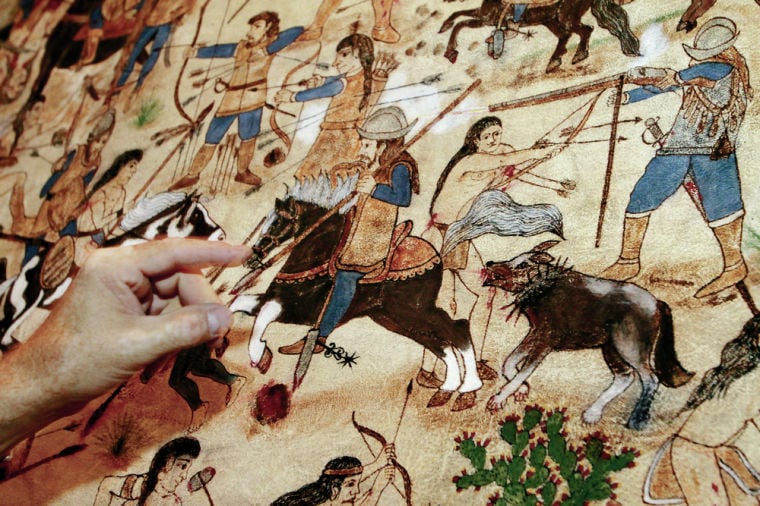
The interior of the chapel is long and narrow consistent with Spanish Southwestern colonial mission architecture. The ceiling is supported by 20 hand carved wood vigas. A large wooden beam holds up the front of the choir loft in the back of the church. On it, carefully inscribed in Spanish, was written, " The Marquis of Penueala. The building was erected by the Royal Ensign Don Augustus Flores Vergara, his servant, in 1710." Several religious paintings grace the walls. In the left rear of the chapel is an early reproduction of Our Lady of Guadalupe. Facing the altar, the painting on the left on buffalo hide is of Christ on the Cross, the painting on the right on deer skin is of Saint John the Baptist. These were painted by he Franciscan friars around 1630 and were used as teaching aids in their work of converting the Indians. Directly to the left of the altar is a painting of the Annunciation, believed to be the work of a disciple of the Spanish painter Murillo. To the right of the altar is an encased Penitente carving of the crucifixion from the early 1700's. The oldest reredos in New Mexico hangs as the backdrop to the altar. This wooden structure which was hand carved and painted in 1798 contains a statue of San Miguel, the patron of the Mission Church. This statue was carved in old Mexico in the 1600's and was brought by the Franciscan missionaries to Santa Fe. Above the statue of San Miguel is a painting of Christ the Nazarene. The 4 oval paintings on the reredos date back over three hundred years. The oval painting at the top to your left is St. Theresa of Avila. Below it is Saint Francis of Assisi. To the right is Saint Gertrude of Germany, and below is Saint Louis IX, king of France.
In 1955 the Christian brothers commissioned an archaeological study of the ancient chapel. The investigation revealed the original sanctuary dirt floor and altar steps as well as the adobe walls burned during the Pueblo rebellion. The dig also uncovered 300 human remains, most believed to be the devout Tlaxcalan Indians, buried beneath the sanctuary floor. The Franciscans, in those ancient days, often made arrangements for the dead to be interred, if possible, under the altar of their Catholic Church in the hope of being remembered in the prayers of the faithful who attended Mass there. On the Sunday I participated in Mass at San Miguel Mission, the history of this Mission church reminded me of the early Christians who settled in New Mexico, their diversity reflected in our contemporary Southwestern Christian population, their perseverance and sacrifice a testimonial to the staying power of their faith, passed on to us. I encourage all Christian pilgrims to visit San Miguel Mission and to remember in their prayers those who first brought the Christian faith to New Mexico.
For more history of San Miguel Mission in Santa Fe click on
SAN MIGUEL MISSION - Rozylowicz
www.rozylowicz.com/pdf-files/mission.pdf
Friday, May 31, 2013
9/11 Memorial at Sacred Heart Catholic Church in Barelas

I recently attended the funeral mass for Father Jim Moore at Sacred Heart Church in the Barelas neighborhood, just south of downtown Albuquerque. I knew Father Moore when he was an associate of the Blessed Sacrament clergy at St. Charles Borromeo parish and would celebrate the 7 A.M. early Mass. During his previous tenure as pastor of Sacred Heart Parish from 1996 to 2006 , Father Jim was a witness to the transformation of the Barelas neighborhood from drugs, gangs and graffiti to art murals and newly painted homes. As part of that transformation Father Moore and his parishioners established a 9/11 Memorial in Sacred Heart Church. Steel girders, each 30 feet in length, were brought from the ruins of the World Trade Centers in New York to the Sacred Heart Church in Barelas in 2003. The parish raised $250,000 to build a towered belfry to house the beams. That belfry today stands atop the Church like a sentinel. The beams were blessed by Father Moore before they were trucked from New York City and again by Archbishop Michael Sheehan upon their arrival at Sacred Heart Church. In the belfry these sacred steel shards have been placed against each other to resemble a cross. Also on display is a wall of engraved granite listing the names of all those who were murdered on 9/11. There is a copper-plated book with names and biographical entrees for each of the deceased. There is a New York State flag, a t-shirt signed by 9/11 rescue workers, a New York City firefighter's helmet and police hats. On the wall facing the steel beams is a religious icon - it depicts the Madonna with her arms encircling the tall World Trade Center towers as twin engine jetliners circle overhead. Next to this icon stands a shrine statue of Our Lady of Guadalupe with an adjacent kneeler for prayers. With arms out she seems to be calling visitors to prayer.
The 9/11 Memorial at Sacred Heart Church in Barelas is both a National and a Catholic shrine. It is a place to reflect on the tragedy that struck our nation that day, the innocent loss of life and the suffering of the victims and their families and friends. It also recalls the individual acts of heroism by police, firemen and other first responders who made the ultimate sacrifice to save the lives of others. The setting of this 9/11 Memorial at Sacred Heart Church enables us to honor the victims and their families with our prayers. It also calls us to contemplate Christ's teachings on forgiveness: Matthew 18:22 - Then Peter came up to Him and said, 'Lord, how often shall my brother sin against me and I forgive him? As many as seven times?' Jesus said to him, 'I do not say seven times but seventy times seven.' In other words Jesus is telling us that we must always forgive. Even in the face of a grave injustice causing great harm- like 9/11? Listen to the words of Jesus on the cross: Luke 34 - 'Father, forgive them for they know not what they are doing.' Jesus asked His Father to forgive His tormentors and those who crucified Him even though at the time most were unrepentant. To forgive is not to forget. Indeed the 9/11 Memorial helps us to remember the injustice of that date. It's just that there is no place for hatred and vengeance when we understand that we belong to God - who has already forgiven us 'seventy times seven'.
Listen to this sermon from Father Robert Barron on 9/11 and forgiveness:

Shrine of The Stations of the Cross - San Luis, Colorado
While driving from Denver to Albuquerque, I stopped in San Luis De La Culebra, Colorado just north of Questa, New Mexico to visit Colorado's newest Catholic Shrine - La Mesa de la Piedad y de la Misercordia (Hill of Piety and Mercy). The shrine's two centerpieces are The Stations of The Cross and La Capilla de Todos Los Santos (The Chapel of All Saints) . The Stations of The Cross are 15 bronze sculptures, depicting the Passion, Death and Resurrection of Jesus Christ, winding up the Hill of Piety and Mercy to the adobe Chapel of All Saints. Each station is strategically placed along a 3/4 mile ascending trail to look out over the San Luis Valley and to the Sangre de Cristo Mountain range. The stations were sculpted by a local artist Huberto Maestas in 1986. The Chapel of All Saints is a domed adobe structure resting atop the Hill of Piety and Mercy and visible across the San Luis Valley. Local architects, Arnold Valdez and Milton Bertin designed and supervised the construction of this elegant Spanish - Moorish styled church. Catholic families from the Sangre de Cristo Parish of San Luis, many of whom trace their ancestry to the original Spanish settlers who farmed and ranched the San Luis Valley by right of a land grant from Spain, donated the building fund for the Shrine.
The Stations of the Cross are by themselves well worth the visit to San Luis, Colorado. Huberto Maestas's statues embrace drama and emotion and capture the sense of movement up the Hill of Piety and Mercy - a San Luis version of Golgotha. The statues are 2/3 life size with the exception of the life size Crucifixion and Resurrection near the top of the mesa. Each statue is meticulously detailed, down to the folds of clothing, and the sharp thorns protruding from the crown of thorns Jesus wore. Most memorable are the expressions on the faces of Jesus, His mother Mary, His followers and tormentors. In successive stations, Jesus' face reveals sorrow, suffering, resolve and compassion. On the last station, the image of the Resurrection, Jesus' face glows with rapture as he points upwards to Heaven. Each station is positioned next to a large bronze plaque, anchored in concrete, bearing the name of the station and the corresponding Bible verses in both Spanish and English. Benches allow the visitor to rest and meditate on the impact of each station. On Friday afternoons during Lent, the priest from the Sangre de Cristo Parish leads parishioners as well as visitors in The Stations of The Cross by walking the Hill of Piety and Mercy. On Good Friday most of San Luis's residents turn out for a procession up the path of The Stations of the Cross and on Easter Sunday, a Lenten veil is removed from the 15th Station to celebrate Christ's Resurrection.
La Capilla de Todos Los Santos ( The Chapel of All Saints) perches atop The Hill of Piety and Mercy and can be seen across the San Luis Valley, conveying a certain Catholic religiosity to this agricultural setting. The Chapel was finished and dedicated in 1997. The Spanish-Moorish architecture suggests an antiquity belying its real age. The walls are thick adobe and whitewashed. Two steeples and a dome afford elegant balance to the building's exterior. The interior of the chapel is remarkable for its simplicity. The wood pews were hand carved and the aisle rug was hand woven by local artisans. On the afternoon I visited, sunlight streamed in thru the porthole windows on the apse wall. An Icon of the Madonna and her Child adorned the south wall. A hand carved Crucifix and Retablos graced the sacristy. The Chapel of All Saints conveyed sacred solitude and peace, commensurate to its location on a hilltop above the Stations of the Cross Shrine.
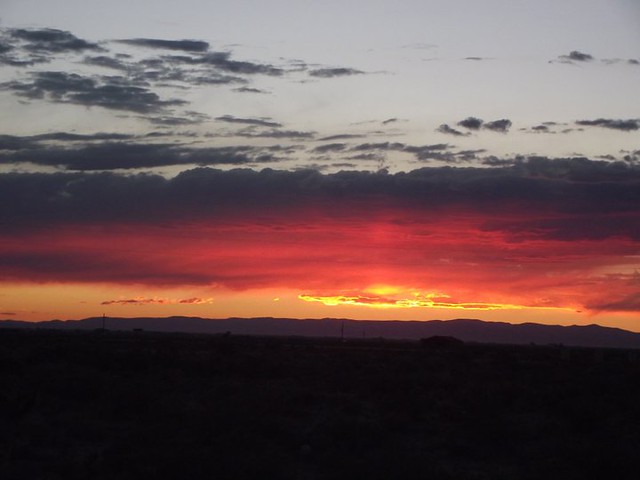
I left the town of San Luis in the evening and drove south down the length of the San Luis Valley to the New Mexico border. The sun was descending over the mountains in the west. It was one of those classic Sangre De Cristo sunsets - rose red then dark red. It reminded me of Willa Cather's description of the Sangre De Cristo Mountains, "those red hills, never become vermilion, but a more and more intense rose carnelian, not the colors of living blood, but the color of the dried blood of saints and martyrs." Indeed the Franciscan Padres initially traversed these mountains and valleys in the late sixteenth century, bringing Christianity to the Native American tribes. Most were martyred for their efforts. A second wave of Franciscan Padres came up the Camino Real in the 17th century and brought Spanish settlers with them. The legacy of those early Franciscan missionaries is evident in the Catholic religious symbolism that is integral to life in the San Luis Valley. The Shrine of The Stations of The Cross is one of those symbols. It is a place where the Christian faith is still prominent, where Christian and other religious pilgrims are welcome to visit.
Watch a video of the San Luis Shrine by clicking
Local Tourist Colorado - San Luis and Stations of the Cross - YouTube
www.youtube.com/watch?v=B1zqm-C0T_Q
www.youtube.com/watch?v=B1zqm-C0T_Q
Subscribe to:
Posts (Atom)